U-Sphere Projects

Un article de U-Sphere - Michael Vaillant.
Revision as of 20:07, 24 février 2026 by Uadmin (talk | contribs) (Created page with "__NOTOC__ {| style="width:100%;" |colspan = "2" | <div style="margin: 0; margin-top:5px; border: 1px solid #dfdfdf; padding: 0 1em 1em 1em; background-color:#f8f8ff; align:cen...")
(diff) ← Version précédente | view current revision (diff) | Version suivante → (diff)
Jump to: navigation, search

Project 1 — The integration of knowledge and beliefs: a “contact” theory

Collecting information in our environment leading to unidentified phenomena
The aim here is to discuss the integration of knowledge, the acceptance of the foreign/unknown, and the beliefs and rationalities that allow us to build bridges toward new social groups and new information that are, a priori, foreign to us. Questions of underlying ethics and morality arise through these topics, notably as enabling factors for implementation. At the psychosocial level, you may notice that certain keywords emerge in the literature, such as “ethnocide”. Beyond fashionable terminology, it is fortunate that humans are (finally) realizing the importance of mastering the beliefs embedded within social groups—beliefs that condition the success (or failure) of rapprochement/integration between ethnic groups. Conversely, deleterious beliefs or overly marked values—locked outward—are likely to generate irrational fears, and even wars. The generational imprinting of beliefs and their transmission can then condition populations for decades.

Psychosocial manipulation”: an unavoidable step?

We will see here that questions of integrating social groups and knowledge are central. We will also examine which tools and methods exist to modify beliefs—for better or for worse.

On that point, “white” (i.e., open) literature is extremely stingy with information: there are in fact only very rare books or sources on psychosocial influence and manipulation, which are essentially reserved for the military (in the US, under the name PSYOP). I encourage—and would gladly contribute to—the creation of documentation that would allow the general public to discover this poorly known subject, which nevertheless has an economic counterpart: marketing (or how to embed values into your belief system, whether they are true or false).

Conditions for achieving an exotic contact?

Of course, we are implying a hypothetical encounter with extraterrestrials. But exoticism is first and foremost “the other”—the one who does not resemble us, or who comes to overturn our values. In the same way, if we learn to spread peace, to induce a mindset of tolerance and openness in those around us—and even more so when that “neighbor” is a country or a nation—then we will discover the true meaning of the word “contact”. Yet, once again, studies on the psychosocial factors of peace are far too rare.

Depending on which side we place ourselves, a more advanced society might, for example, need a number of tools and means to implement a “contact plan”. Among these would be the use of certain nodes in the network it wishes to penetrate (cf. PSYOP).

Let’s have fun and try to imagine what the characteristics of a human node might be:

  • TO COME: table: what makes a good “contact” (<> contexts)
    • The dual use of contact: fine-grained sampling and controlled dissemination of information.
  • Countermeasures and mastery of the “game”:
    • PSYOP operations are notably designed to leave decoys—false information—on which “the outsider” will build false theories, *apparently coherent* but in reality inaccurate. Likewise, any information communicated to a contact/infiltrator cannot have a “critical” character [ref]

Arrow green.gif Toward preparation for contact

Side paths

The example of the “SBF” affair (Seth Brundle Fly) that took place on the ummo-sciences mailing list is revealing. It is also at the origin of this chapter. It is also the story of interference by one or several “exotic” sources.

Project 2 — Environmental monitoring and anticipation: exotic “interference”?

Example: detecting the nitrogen cycle and the impact of human activity
By definition, complex systems cannot be modeled perfectly, and neglected data can lead to considerable effects. In order to produce forecasts, it is necessary to continuously refine one’s knowledge of the environment: computer modeling can then be seen as a “pursuit” system that continuously re-aligns itself with reality.

As with meteorology, this requires placing sensors within a social system in order to anticipate and predict its (re)actions. As you will read, studying and collecting information about the target environment—in this case, the social group one seeks to understand or master—is part of a strategy of contact and rapprochement. Or, at the very least, part of an effort to understand and thereby manage environmental risks that may occur.

It is, quite simply, about developing intelligence strategies on environments that are what we call complex systems. It is understood that once intelligence is collected, strategies for environmental control can be designed and implemented.

Complexity: the science of the 21st century and beyond?

It is likely that the evolution and levels of complexity reached by systems—especially living systems—will become an increasingly crucial subject of study for humanity. A key domain whose mastery could provide the means for a better understanding of our own evolution.

From this perspective, monitoring and understanding the vectors or variables that shape the destiny of Earth’s biotope and of its evolved forms (humanity or complex systems) could indeed constitute a particularly relevant field of study.

In any case, approaches to complexity levels—and the way exo-civilizations might view the different “infospheres” they encounter—should vary greatly depending on their degree of technological, social, and of course moral evolution.

As a result, their involvement in our environment could vary widely: from complete ignorance, to surveillance, to interference at different degrees. More broadly, the need to monitor our environment and surround it with invisible probes seems to constitute a “minimal” precaution.

Arrow green.gif Les systèmes complexes sous surveillance exotique ?

Collecting information to build predictive models of the complex systems in which we are immersed should be of interest both to hypothetical advanced civilizations—and, increasingly, to humans.

Under the hypothesis that deploying and then monitoring sensors, probes and information-collection means could constitute a research project capable of generating “exotic” activity, we seek to test the following idea:

H1: is an “intelligent” exogenous manifestation correlated with the main variables likely to significantly impact our biosphere—i.e., does it track the variables likely to call into question the evolution of the levels of complexity achieved on Earth?

Which can be reformulated more narrowly as follows:

H1': could this “intelligent” exogenous manifestation correspond to certain “unidentified flying phenomena”? (OVNIs, UFOs, UAPs...)

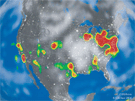
To test this hypothesis, we propose to search, within databases of unexplained phenomena, for correlations with environmental parameters that have a major influence on the stability of our biosphere.

Below, click on the link—not on the thumbnail:

Risques.gif Risques2.gif Database2.gif Quantification.gif Evaluation.gif Qualification.gif Pressions.gif CorrelationsUS.gif Analyse.gif
1. Biosphere risks 2. Modeling 3. Storage 4. Projection 5. Evaluation 6. Mapping 7. Tension map   8. Geo correlations    9. Chronological correlations
Beyond surveillance: control?

A hypothesis that would be compatible and coherent with the surveillance scenario.